Admin
Admin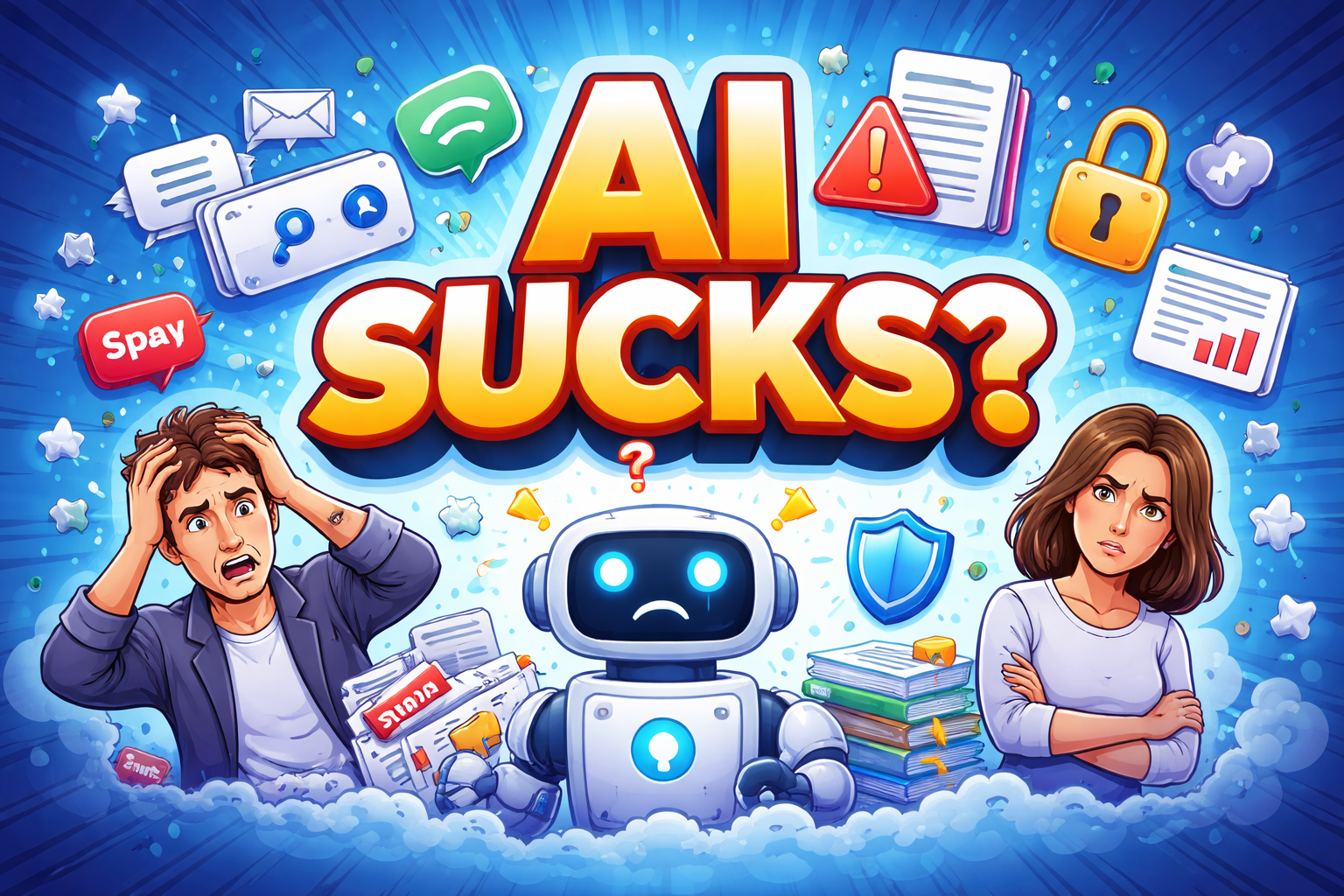
Introduction: Why “AI Sucks” Is Trending
The phrase “AI sucks” has become surprisingly popular in recent years. While artificial intelligence is transforming industries, improving efficiency, and powering innovation, many users still feel frustrated, disappointed, or even threatened by it.
But does AI really suck? Or is this keyword simply a reflection of growing pains in a rapidly evolving technology?
In this article, we’ll explore why people say “AI sucks,” the real challenges of AI, its limitations, and whether these concerns are justified. We’ll also look at how AI is improving—and why it might not “suck” as much as some think.
What Does “AI Sucks” Really Mean?
When people search for or say “AI sucks,” they usually aren’t rejecting artificial intelligence entirely. Instead, they are expressing frustration with:
- Poor AI-generated content
- Inaccurate responses
- Job displacement concerns
- Ethical and privacy issues
- Overhyped expectations
In short, “AI sucks” is less about hate—and more about disappointment.
1. AI Still Makes Mistakes
One of the biggest reasons people believe AI sucks is because it isn’t perfect.
Common Issues:
- Incorrect information
- Misunderstanding context
- Producing repetitive or generic outputs
- Lack of real-world awareness
For example, AI tools sometimes generate confident answers that are completely wrong. This creates trust issues, especially when users rely on AI for important tasks.
Reality Check:
AI is still learning. It relies on data patterns, not true understanding. While it’s improving rapidly, it’s not a replacement for human judgment yet.
2. AI-Generated Content Feels Robotic
Another major complaint behind the keyword “AI sucks” is the quality of content.
Why Users Feel This Way:
- Content can feel generic
- Lack of emotional depth
- Repetitive phrasing
- Overuse of common structures
This is especially noticeable in blog writing, marketing copy, and social media posts.
The Truth:
AI can produce high-quality content—but only when guided properly. Poor prompts often lead to poor results.
👉 In other words, AI doesn’t suck—bad usage does.
3. Fear of Job Replacement
A major reason why people say AI sucks is fear.
Concerns Include:
- Automation replacing human jobs
- Reduced demand for writers, designers, and developers
- Companies relying more on AI than human talent
This fear is understandable. AI tools can now:
- Write articles
- Generate designs
- Build code
- Automate customer service
The Reality:
AI is not replacing jobs—it’s reshaping them.
New opportunities are emerging, such as:
- AI content editors
- Prompt engineers
- AI tool specialists
- Automation consultants
Instead of eliminating work, AI is changing how work is done.
4. Ethical and Privacy Concerns
Many critics argue that AI sucks because of ethical issues.
Key Problems:
- Data privacy concerns
- Bias in AI algorithms
- Lack of transparency
- Misuse of AI (deepfakes, misinformation)
These are serious challenges that cannot be ignored.
Why It Matters:
If AI systems are trained on biased data, they can produce biased outcomes. This affects fairness, especially in areas like hiring, finance, and law enforcement.
5. Overhype vs Reality
Another reason people say “AI sucks” is the gap between expectations and reality.
The Hype:
- AI will replace humans
- AI can do everything
- AI is always accurate
The Reality:
- AI still needs human supervision
- It struggles with complex reasoning
- It lacks creativity in many cases
- It cannot fully understand emotions
When expectations are unrealistic, disappointment is inevitable.
6. Dependency on AI Tools
Some users feel that AI sucks because it creates dependency.
Problems:
- People rely too much on AI for thinking
- Reduced critical thinking skills
- Over-automation of simple tasks
For example, students using AI for assignments without understanding the material can harm their learning.
The Balance:
AI should be a tool—not a replacement for human intelligence.
7. Lack of Creativity and Originality
Despite its capabilities, AI still struggles with true creativity.
Limitations:
- Cannot create original ideas like humans
- Relies on existing data
- Often produces predictable outputs
This is why many creatives—writers, artists, designers—say AI sucks.
The Truth:
AI is great for inspiration and assistance, but human creativity remains unmatched.
8. Technical Limitations of AI
AI systems still have several technical constraints:
- Limited real-time awareness
- Dependence on training data
- Difficulty understanding nuance
- Struggles with complex emotions
These limitations contribute to the perception that AI sucks, especially when users expect perfection.
Why AI Doesn’t Actually Suck
Despite all the criticism, AI offers incredible benefits.
1. Saves Time
AI automates repetitive tasks, allowing humans to focus on important work.
2. Boosts Productivity
From writing to coding, AI speeds up workflows significantly.
3. Enhances Creativity
AI can generate ideas, drafts, and concepts quickly.
4. Improves Accessibility
AI tools help people with disabilities, language barriers, and learning challenges.
5. Drives Innovation
AI is powering advancements in healthcare, finance, education, and more.
The Real Problem: Misuse of AI
Let’s be honest—most complaints behind “AI sucks” come from poor usage.
Examples:
- Using vague prompts
- Expecting perfect results instantly
- Relying on AI without editing
- Ignoring human oversight
When used correctly, AI becomes a powerful assistant—not a problem.
How to Use AI Effectively
If you think AI sucks, try improving how you use it.
Tips:
- Be Specific – Give clear instructions
- Edit Outputs – Don’t rely on raw AI results
- Use AI as a Tool – Not a replacement
- Experiment – Try different prompts
- Stay Involved – Add your human touch
The Future of AI: Will It Still “Suck”?
AI is evolving rapidly. In the next few years, we can expect:
- More accurate responses
- Better understanding of context
- Improved creativity
- Stronger ethical regulations
- Enhanced user control
As these improvements happen, the phrase “AI sucks” may slowly disappear.
Conclusion: Does AI Really Suck?
So, does AI suck?
Not really.
The phrase reflects frustration—not reality. AI has limitations, but it also offers massive benefits. Most issues come from unrealistic expectations, misuse, or the early stage of the technology.
Instead of saying “AI sucks,” a better perspective might be:
👉 “AI is powerful—but still evolving.”